The Spring Week Application Playbook · v1.0 · 2026-27 cycle
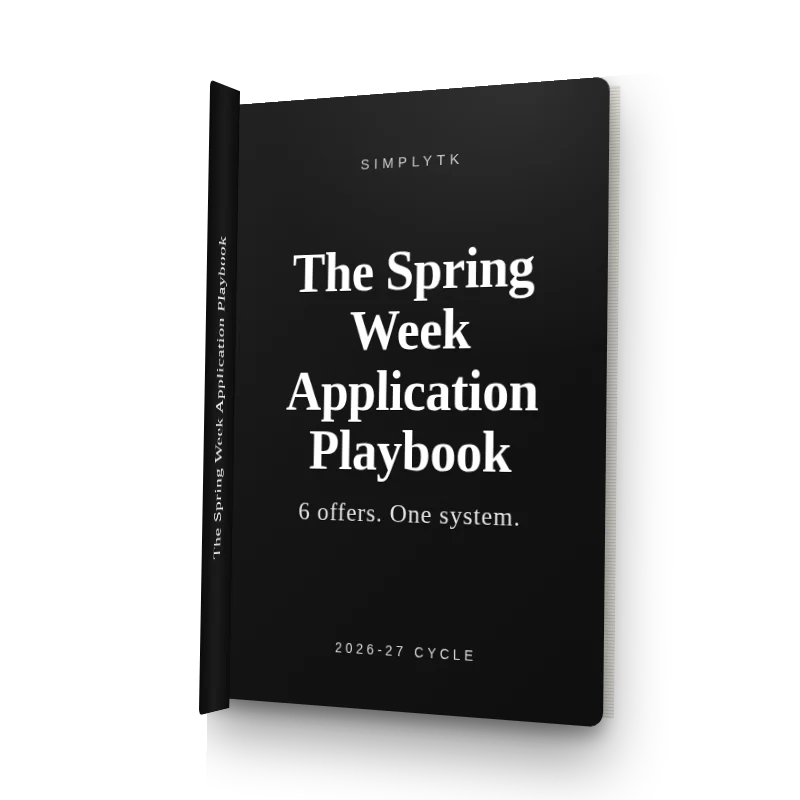
Six spring week offers. One system. Written down.
One first-year cycle, six offers: two market makers, a multi-strategy hedge fund, a bulge bracket bank, a US investment bank and an economic consultancy. This is the exact system behind them. Every stage, every framework, every template and script, in the order you will need them. Including the two chapters nobody else writes: trading firms, and what happens after you get in.
One-time payment · Instant PDF download · Every future edition free
~60
applications
56
reached a test or HireVue
7
final rounds
6
offers
Read that funnel carefully, because it contains the whole strategy. The CV screen barely rejected me. The bloodbath is the middle: tests, HireVues and early interviews. And final rounds convert if you get there. Final rounds also at three multi-strategy or quant funds and a prop trading firm. Every firm here is named on my LinkedIn if you want to check.
Why this one
Most spring week content is a listicle, a coaching funnel, or one person's IBD story.
It covers trading firms properly.
Almost every guide is written by someone who only did banking. The trading firm process, with its mental maths tests, probability questions and market making games, is completely different, and nobody covers it in depth. Part 10 does.
It covers what happens after you get in.
The offer is not the finish line. Conversion to a summer internship is decided during the week itself, and most guides end at the assessment centre. There is a full chapter on converting, with four real weeks compared.
It is a system, not a story.
The calendar, the frameworks, the question banks, the scripts and the checklists, in the order you will actually need them. Plus the real cover letter that worked, annotated line by line.
It is honest about luck.
Anyone with offers is one data point. Where something is my opinion rather than a repeatable mechanic, it is flagged. Every figure in the firm map is tagged verified or community-reported.
What's inside
Fifteen parts, one appendix, 47 pages. No filler.
The game
What a spring week actually is, why the numbers make it worth taking seriously, the six stages every firm builds its process from, and an honest preface on how much is luck.
Choosing your lane
IBD, sales and trading, prop trading, asset management, consulting and economic consulting in plain English, from someone who did weeks on both sides, and how to actually choose at 18.
The firm map and portfolio strategy
Bulge brackets to commodity houses. Three tiers of 15-40 firms, conversion-aware targeting, and the sequencing rule: never let your first attempt at any stage be at a Tier 1 firm.
The calendar
Month by month from the summer before first year to offers, and why a finished CV in August beats a slightly better one in November.
The CV
The real bar, the formatting rules, the CAR formula for every bullet, the interests line interviewers actually ask about, the template, and the kill-list of mistakes.
Written questions and cover letters
The competitor-swap test, the raw materials for a 'why this firm' that passes it, the five behavioural stories, and the real cover letter that won an economic consulting offer, annotated line by line. Plus the four AI research prompts I actually ran.
Networking, the multiplier
The outreach sequence, three LinkedIn scripts that work word for word, name-dropping etiquette, and the honest reason my reply rate ran around 85%.
Online tests
Every test type, how to find which provider each firm uses, the 4-6 week plan, what to do in the test, and the SJT trick almost nobody uses.
HireVue and pre-recorded interviews
The mechanics, the full question bank from my own cycle, the frameworks assessors literally checkbox-mark, delivery, and why a script loses you the live rounds.
Trading firms: the chapter nobody else wrote
The 80-in-8, the market making game and how it is marked, the probability archetypes, the recovery table, the five skills every trading simulation tests, and what the Citadel, Optiver and IMC weeks were actually like.
Live interviews
What changes from HireVue, the honest scope of technicals by firm type, dictated case studies, brainteasers, your questions at the end, and the 20-minutes-a-day commercial awareness system.
Assessment centres
The discussion question types and the group exercise playbook: second loudest, timekeeper, build on people by name, yes-and.
Converting the week
The offer is the semi-final. Before, during, the end-of-week assessment and after, with a hedge fund week, a trading week, a bank week and an economic consulting week compared.
When it goes wrong
Rejections as the base rate, no spring week at all, a week that did not convert, grades below the bar. Every route forward.
The toolkit
The tracker workflow that runs the whole cycle, the pre-flight checklists for every stage, and the full resource stack, free and paid.
Appendix: the firm map, firm by firm
40+ programmes across bulge brackets, elite boutiques, mid-market banks, trading and quant firms, asset managers, consulting and access schemes. Each with its stages, test provider, deadlines, reported questions and conversion reputation, every claim tagged verified or community-reported.
Try before you buy
The free edition is real. The full one is the rest.
The free edition is the compressed system: enough to change how you apply this week, with nothing held back inside it. The full playbook is everything the compression leaves out.
| What you get | Free edition | Full playbook · £19.99 |
|---|---|---|
| The whole system in eight rules | Included | Every rule expanded into its own part |
| The six stages every firm uses | Included | Plus which stages each of 40+ firms actually runs |
| The calendar | The shape of the year | Month by month, with the summer block |
| The CV | The kill-list of eight mistakes | The bar, the CAR formula, the interests line, the template |
| Written answers | The competitor-swap test | The raw materials, the arc, and a real annotated cover letter that worked |
| Networking | One connection script | The full sequence, three scripts, etiquette and reply rates |
| Pre-flight checklists | Included | Included |
| Online tests | Not included | Every type, every provider, the 4-6 week plan, the SJT trick |
| HireVue question bank | Not included | Motivational, behavioural, commercial and macro-technical |
| Trading firms | Not included | The 80-in-8, the market making game, probability, the weeks themselves |
| Live interviews and assessment centres | Not included | Two full parts |
| Converting the week | Not included | Before, during, the assessment, after |
| The four AI research prompts | Not included | Included |
| Firm-by-firm appendix | Not included | 40+ programmes, tagged verified or community-reported |
| Future editions | Not included | Every update, free |
A page from part six
The competitor-swap test.
One of the frameworks, as it appears in the playbook, so you can see the level of detail before you buy.
Excerpt
"The single most useful quality check ever devised for these answers: read your 'why this firm' answer and mentally replace the firm's name with its closest competitor. If the answer still works, it has failed. Specificity comes from named recent deals, programme names, awards, annual report details, regions and sector strengths, and, with permission, named employees you have spoken to. This takes effort, which is exactly why it works: most applicants recycle one letter across ten firms and it is obvious."
What the rest of the part does with it
The test tells you whether an answer fails. The next three sections tell you how to make one pass: the raw materials to collect for every Tier 1 and Tier 2 firm before writing, the journey structure for "why the industry", and the two anchors for "why me".
Then the real cover letter from my successful economic consulting application, all three written questions, with a note under each paragraph on why it is there and what it proves. Nothing in it could have been written by someone who had not done it, which is the entire test.
About the author
Tanuj Kakumani
I study Economics, Finance and Data Science at Imperial College London, class of 2028. In my first-year cycle I received six spring week offers, across banking, trading and economic consulting, and reached final rounds at several of the most competitive firms in the industry. Everything in this playbook is the system behind that cycle: what I did, in the order I did it, with the frameworks and materials I actually used.
Alongside the degree I founded A* AI, an AI tutoring platform used by 10,000+ UK students, and I build the free tools on this site: the live internship tracker, the OA prep suite and the interview course, all of which the playbook plugs into. Don't take my word for any of the above. It is all on my LinkedIn, in the experience section.
What it costs
£19.99. Once. For the whole cycle.
Less than one firm-specific test pack, a third of a single 30-minute call, and a rounding error next to what a London front-office summer pays. If it gets you one HireVue further at one firm, it has paid for itself many times over. Every future edition is free to buyers.
One-time payment · Instant download
FAQ
Common questions.
Who is this for?
First years on three-year degrees and second years on four-year degrees applying to spring weeks and insight programmes in banking, trading, asset management and consulting. Year 13s who want the summer before first year to count will get the calendar and the CV part working straight away.
What do I get after paying?
The PDF, instantly. A download link appears on the success page as soon as payment goes through, and the purchase is stored against your email so you can request a fresh link any time.
Is this a one-time payment or a subscription?
One-time payment of £19.99. No subscription, no upsell inside it, and every future edition is free to buyers.
Isn't most of this free online?
The tools are, and they always will be: the live tracker, OA prep and the interview course are free on this site and the playbook points at them. What is not free anywhere is the insight layer: the funnel numbers, the real cover letter, the trading firm chapter, the chapter on converting the week, and 40 firms mapped stage by stage. Most free guides were written by someone who only did banking and stop at the assessment centre.
What is in the free edition?
The eight rules the whole system compresses to, the six stages, the shape of the calendar, the CV kill-list, the competitor-swap test, one outreach script and the pre-flight checklists. Enough to change how you apply this week. Everything else is in the full playbook.
Is it current?
This is v1.0, September 2026, written for the 2026-27 cycle. The firm appendix was last verified in September 2026 and every dated claim is tagged as verified or community-reported. Firms change their processes, so the live tracker is the living version, and buyers get every update to the PDF.
Does it guarantee an offer?
No, and it says so on page seven. Plenty of people do everything right and get nothing. What it does is maximise the part you control: quality, volume and timing. Most applicants are bad at all three.
What if I lose my download link?
Enter the email you paid with at the bottom of this page and we will email you a fresh signed link. Links expire for security, but you can request new ones any time.
Refunds?
Because it is a digital download you get immediately, refunds are not available once the link has been issued. If something is wrong, email official.simplytk@gmail.com and I will make it right.
Already bought?
Resend my download link.
Enter the email you paid with and we'll email you a fresh signed download link.
Still at school and applying to Imperial's Economics, Finance and Data Science? The EFDS Playbook (£29.99) is the admissions version of this: eight real personal statements, the interview broken down and a full TMUA prep ladder.