OA Prep
Which online assessment does your firm send?
Pick the firm, see who builds its test, and start the drills that train it. Every one of the 31 games here is free, and the ranked ones put you on a board against people applying to the same places.
Pick a firm to see who builds its test and which drills here train it. Not applying anywhere yet? Start with today's challenge.
New to this? Start here.
If you have never sat an online assessment, this is the whole thing in three paragraphs.
Where it sits
The OA lands within days of your application and is usually marked automatically. Clear it and you get an interview. Miss the bar and nobody reads the rest.
What it measures
Arithmetic speed, pattern spotting, working memory, reaction and how you behave when the questions get hard. Very little of it is A-Level content and almost none is finance knowledge.
Why practice works
The formats repeat year on year. The gap between a cold first attempt and a tenth attempt is large, and it is the cheapest advantage available to a first year.
Your weak spots.
Every ranked run of the question drills is kept with its questions and your answers, so the site can see which kinds you get wrong: a numerical question family, cannot say statements, a logic verdict, what moves in a figure series, a Motion tier. A category is called weak once you have met it a few times and it sits clearly below your own average in that drill. Where a drill can, the link starts a run weighted toward it; those runs are recorded here but not ranked.
Sign in and play a few ranked runs of the question drills, and this fills in with the kinds of question you get wrong. Sign in
Speed and numeracy
The maths round. Almost every quant and trading process opens with one of these, and a lot of banking numerical tests are a slower version of the same thing. This is the group to start with, because it is the one where practice moves your score the most.
Mental Maths
One page with the exam formats (80 in 8, 80 in 8 typed, 50 in 5) where decimals, fractions, percentages and missing operands appear and a wrong answer costs a point, and the ranked drill, which is the four operations one question at a time with the next appearing the instant you are right. The ranked drill runs 30s, 60s, 120s or 300s; the 120 second game with all four operations is the one that scores.
- Optiver
- Flow Traders
- IMC
- Cappfinity
- What it tests
- Raw arithmetic throughput, and on the exam formats, whether you know when to skip. Your ranked score is how many you clear, not a percentage, so hesitation is the thing that costs you.
- Where you will meet it
- The opening test at most prop and market making firms (Optiver, Flow Traders, IMC and similar), and a fair proxy for the numerical reasoning tests banks use.
- How to get better
- Nothing is deducted for a wrong keystroke, the question only clears when the answer is right, so type immediately and correct as you go. Learn times tables to 20 and get comfortable dividing by 7, 11 and 13.
Fast Fractions
A fraction appears with five decimal options and you pick the right one. Values are checked to three decimal places, so 7/16 is 0.4375 and 3/8 is 0.375. One wrong pick voids the question: the right answer still moves you on, but it no longer scores.
- Optiver
- IMC
- What it tests
- Recall rather than calculation. Trading tests assume you already know these and are timing something else.
- Where you will meet it
- Inside mental maths rounds, and in market making questions where prices move in halves, quarters, eighths and sixteenths.
- How to get better
- Memorise the conversions from halves through twentieths. Anything with 8, 16, 32 or 64 underneath should be instant, not worked out.
Sequences
A run of terms appears and you type the next one. Questions come from a verified bank and include fractions and powers, not only arithmetic steps.
- Optiver
- Flow Traders
- Suited
- What it tests
- Pattern recognition under time pressure, plus the discipline to abandon a wrong idea quickly rather than forcing it.
- Where you will meet it
- Sequence rounds in trading assessments, including the Optiver, Flow Traders and Maven style tests, and the numerical sections of graduate aptitude tests.
- How to get better
- Work through it in a fixed order: first differences, then second differences, then ratios, then two interleaved sequences. If nothing lands in a few seconds, skip and take the next one.
Numerical Reasoning
Twelve questions in eighteen minutes, ninety seconds each. Every question shows a table of three to five rows (regions, offices, product lines, funds, quarters) and asks one thing: which row is largest, what share of the total, the percentage change, the figure per head, next year's figure at a stated rate, a conversion into dollars, or a two-step margin question. One point per correct answer, nothing deducted, skipping allowed, no feedback until the end.
- SHL
- Cappfinity
- Talent Q
- Suited
- Saville
- What it tests
- Data interpretation under time: reading the right row and the unit in the column header, choosing the right base for a percentage, and estimating well enough to rule most options out before doing the arithmetic. Every wrong option is the number a specific mistake produces.
- Where you will meet it
- SHL's Verify numerical tests (Barclays, Deutsche Bank, Jefferies), the numerical module in Cappfinity's immersive assessments (HSBC, Lloyds) and Korn Ferry's Talent Q Elements numerical (Citi, UBS).
- How to get better
- Read the units and column headers before the question, work out exactly what is being asked before touching the numbers, estimate first to kill three of the five options, and skip anything that needs more than two minutes.
Data Statements
Six tabs (Income, Costs, Market share, Employees, Return on equity, Outlook) about one fictional company, and a statement under them to judge true, false or cannot say. Thirty seven statements in twelve minutes, about twenty seconds each, roughly a third of each answer. One point per correct answer, nothing deducted, skip allowed. The tab you had open is recorded for the readout at the end but never scored, and every miss is shown with its answer, its tab and the figures that settle it.
- Aon
- Nomura
- UBS
- Morgan Stanley
- What it tests
- Finding the right tab fast and computing one figure from it: a comparison, a percentage change, a share of a total, a ranking, or a figure that needs two tabs. And the discipline to answer cannot say when the fact is not there, however plausible the statement sounds.
- Where you will meet it
- Aon's scales numerical (formerly cut-e), the numerical reasoning test Nomura, UBS, Morgan Stanley and BNP Paribas send for spring weeks and internships, and the numerical half of what Nomura sends alongside Motion.
- How to get better
- Read the six tab names before the first statement so you know where each fact lives. The statement usually names its tab. If the fact is on no tab the answer is cannot say, and twenty seconds means you never compute more than one figure.
Daily Challenge
Eight sequences, easiest first, once a day. Up to 30 minutes with the clock as the tiebreaker, a daily board, a shareable result and a streak that resets if you miss a day. New challenge at midnight UTC.
- What it tests
- Consistency more than ability. It exists so that prep is a habit instead of a panic the night before a deadline.
- Where you will meet it
- Not a test format in itself. It is the daily rep that makes the rest of this page work, and the easiest way to compare yourself with people on your course.
- How to get better
- Do it at the same time every day. Ten minutes a day for a term beats a weekend of cramming the week applications open.
Markets and estimation
The judgement games. These are the closest thing on the site to what a trader actually does: price something with incomplete information, decide whether the price on offer is wrong, and be willing to do nothing when it is not.
Make a Market
You quote a bid and an ask on the sum of some dice, and a counterparty trades against you. Part of that flow already knows the settlement value and only trades when your quote is wrong; the rest walks if your quote is too wide. One more die is revealed after every round.
- Optiver
- IMC
- SIG
- Jane Street
- What it tests
- Quoting under adverse selection. Tight quotes get picked off by the informed side, wide quotes get no fills at all, and the width that survives both grows with how much is still hidden.
- Where you will meet it
- The market making exercise trading firms run in interviews and assessment centres, at Optiver, IMC, SIG and Jane Street among others.
- How to get better
- Start wider than feels comfortable while most of the dice are hidden, then tighten as they come up. The game scores your quote against the exact fair value, so a good quote that happens to lose still scores well.
Pot Odds
Four question types, all answered as a whole percentage: break-even equity, minimum defence frequency, bluff frequency and outs to equity. Two minutes, and the numbers stop dividing nicely in the back half.
- Trading interviews
- What it tests
- The indifference arithmetic behind any risk and reward decision, done in your head and to the nearest percent rather than exactly.
- Where you will meet it
- Poker questions in trading interviews, which come up far more often than the poker content suggests, and any question asking what price makes a bet break even.
- How to get better
- Break-even equity is risk over risk plus reward. Learn that one shape and three of the four kinds fall out of it. Answers are accepted in a band, so estimate rather than dividing precisely.
Dice Markets
Some dice are face up, some hidden. A dealer quotes a bid and an ask on the total. You buy if the ask is too low, sell if the bid is too high, and pass if the quote is fair. Difficulty presets change how many dice are hidden, how tight the quotes are and how long you get per round.
- Prop firms
- What it tests
- Expected value under uncertainty, and the discipline to pass. Trading firms care as much about whether you trade a fair market as whether you spot a bad one.
- Where you will meet it
- Market making rounds and trading games at prop firms, and the on-the-spot pricing questions in trading interviews.
- How to get better
- A hidden die is worth 3.5. Add the visible faces, add 3.5 for each hidden one, then compare with the quote. Passing on a fair market is a correct answer, not a wasted round.
Card Markets
A dealer quotes a bid and an ask on the sum of five cards, some face down. Unlike dice, cards are drawn without replacement, so what has already been revealed changes what the hidden cards are worth.
- Prop firms
- What it tests
- Expected value with conditional information, and updating a price when new information arrives mid round.
- Where you will meet it
- Card based trading games in prop firm assessments and superday market making exercises.
- How to get better
- Look at what is already showing before you price the rest. If the visible cards are high, the unseen ones are worth less than the deck average, and the fair value moves with them.
Probability
Six minutes of probability, one question at a time and no going back. Expected value and waiting times first, then binomial and without-replacement questions, then conditional probability and screening tests. Five options, +1 for a correct answer, 1 off for a wrong one, and skipping is free.
- Optiver
- SIG
- What it tests
- Whether the standard families are automatic rather than worked out from scratch, and whether you can tell a question you can do from one you cannot before the clock decides for you.
- Where you will meet it
- The probability sections of trading assessments, Optiver's Beat the Odds among them, and the SIG Problem Solving Assessment at a slower pace.
- How to get better
- Guessing at random loses marks on this scoring, so skip anything you cannot see a route through in a few seconds. Every wrong option is the answer to a specific mistake, so if one looks obviously right, check which mistake makes it right.
Fermi Estimation
Eight questions, 45 seconds each by default, drawn from a 500-question bank modelled on the estimation questions trading interviews actually use: markets, cities, packing problems and classic Fermi counts. For each one you give a low and a high that you are 90% sure contains the answer. Capturing the true value scores, and the tighter the interval the more it scores. Miss it and the question is worth nothing.
- Consulting
- Optiver
- What it tests
- Structured estimation and calibration: whether you actually know how much you know.
- Where you will meet it
- Consulting case maths, trading interview brainteasers and the estimation questions Optiver style firms use to see how you reason out loud.
- How to get better
- Break the question into factors you can each get within a factor of three, then multiply. Keep intervals honest: tight when you know the answer, wide when you are guessing. Hedging everything scores badly.
Cognitive and reaction tests
The gamified assessments. Banks and trading firms increasingly screen with short psychometric games rather than a maths paper, often through providers like Arctic Shores. You cannot revise for these the way you revise for maths, but the formats are unfamiliar the first time and familiar the tenth, and that alone is worth several points.
Switch
Two rows of four symbols, what went in and what came out, and an operator is the four digit code that rearranged them. The job is to name the operator, not to work out the output. Later levels chain two operators and hide one, and the hardest give you the second stage so the first has to be solved backwards.
- Aon
- BNP Paribas
- What it tests
- Deductive reasoning against a clock, and specifically reading a transformation backwards, which is a different skill from applying one forwards.
- Where you will meet it
- Aon's switchChallenge, used by BNP Paribas among other banks, and the deductive sections of graduate aptitude batteries.
- How to get better
- Read the output row first and work out where each symbol came from. Checking only the first digit is exactly what the near-miss options are built to punish, so verify all four before committing.
Operators
A row of shapes goes in, one or more operators run on it in order, and a row comes out. A panel says what each operator does. One part of the flow is missing: the output at first, then an operator, then the input, which means running the chain backwards. The letters are reshuffled every question so there is nothing to memorise.
- Saville
- IMC
- What it tests
- Holding several freshly given rules in working memory while applying them, and inverting a process rather than just following it.
- Where you will meet it
- The diagrammatic and abstract reasoning sections of graduate aptitude batteries, including the Saville tests IMC uses, and the logical reasoning parts of consulting and banking screens.
- How to get better
- Read the whole panel before you look at the shapes, and check one attribute at a time: order first, then shape, then fill. On the backwards questions, take each option and run it forwards rather than trying to undo the chain in your head.
Inductive Reasoning
Nine tiles of abstract shapes. Eight obey a rule nobody tells you and one does not, and the job is to pick the one that does not, twenty times in five minutes. Early items hang the rule on one property you can see at a glance. Later ones tie two together, so the rule is something like solid whenever the count is even.
- Aon
- UBS
- What it tests
- Inductive reasoning: generating candidate rules from examples and discarding them quickly, which is a different skill from applying a rule you have been given.
- Where you will meet it
- Aon's scales ix, which UBS sends as its inductive reasoning test, and the abstract or diagrammatic sections of most graduate aptitude batteries.
- How to get better
- Check one property at a time rather than staring at the grid: shape, colour, count, solid against hollow, then the marks inside. Eight against one on any of them is the answer. If none splits cleanly the rule pairs two properties, and fill against count is the usual pair.
Motion
A six by six grid with a ball, an exit and blocks in the way, and from the sixth puzzle on fixed walls. Slide any piece along a row or column to clear the ball's route and bring it to the exit. A move is one slide, however far it travels. Six minutes, forty puzzles easiest first, two points for a solve and a third for doing it in the fewest moves the puzzle allows. Two warm-up tiers, then it climbs to boards with up to ten blocks that need nine or more block moves in the right order, which is harder than most accounts of the real thing.
- Aon
- Nomura
- What it tests
- Planning: holding a route in your head and ordering the moves that clear it before you touch anything. Aon labels it complex planning capability, and the move counter is there to punish shuffling pieces to see what happens.
- Where you will meet it
- Aon's motionChallenge, which Nomura sends with its spring week and internship online assessment, and the Aon smartPredict batteries other employers use.
- How to get better
- Trace the ball's path back from the exit, count what sits on it, and move the biggest blocker first. Park blocks against an edge so they never need a second move, and reset the moment a plan dies rather than shuffling your way out of it.
Figure Series
Four abstract figures, each following on from the last, and five candidates for the fifth. Every figure is set by its shape, how many of it, solid or hollow, colour, and on harder items a dot walking round the corners, each following its own rule. Fifteen items in eighteen minutes, easiest first: one attribute changes at first, then two, then three or more with the dot always among them.
- SHL
- Talent Q
- Plum
- What it tests
- Inductive reasoning in its commonest form: reading several independent rules off a short series and applying each one step further, under a clock that allows about a minute an item.
- Where you will meet it
- SHL's Verify inductive reasoning test, which Barclays sends inside Verify Interactive G+ and Deutsche Bank and Jefferies send in the classic form, Korn Ferry's Talent Q Elements logical test used by Citi and UBS, and the problem solving sections of Plum's Discovery Survey used by Citi and Bloomberg.
- How to get better
- Check one attribute at a time, always in the same order: shape, count, fill, colour, dot. Say the rule for each before you look at the options, even when it is "stays the same". Then throw out each option on the first attribute it gets wrong; one wrong attribute is always enough.
Logical Statements
Two, three or four statements about a small group (all analysts work late, no one who works late takes the train, Priya is an analyst), then a further statement to judge as always true, sometimes true or never true taking the statements as given. Sixteen items in ten minutes, easiest first, one point each and nothing deducted. Every answer is computed by checking the statement in every arrangement that fits the premises, and every item you miss is explained at the end.
- Suited
- PJT
- Evercore
- What it tests
- Deduction under a clock: following a chain of alls and nos, reading some as at least one and nothing more, and recognising when the statements simply do not settle the question, which is the verdict most often missed.
- Where you will meet it
- The logical reasoning section of the Suited assessment, which PJT Partners, Evercore, Houlihan Lokey and Guggenheim send to investment banking applicants, and the syllogism items in most graduate reasoning batteries.
- How to get better
- Draw the circles. All puts one inside another, no pulls two apart, some is a single cross in the overlap. Then try to make the question false while keeping every statement true, and try to make it true; if you can do both it is sometimes, and bring in nothing you know from outside the statements.
Situational Strengths
Fifteen scenarios from a spring week or an internship, each with four things you could do, ranked by tapping them in order. Ten points a scenario when your order matches the key, fewer the further from it you are, nothing for the key reversed. Untimed in the real test but speed scored, so the time on each scenario is shown and the run is capped at fifteen minutes.
- Cappfinity
- HSBC
- Lloyds
- SHL
- What it tests
- Judgement and ownership rather than knowledge: whether you keep the right person informed, own a mistake straight away, escalate without going over heads, and do the right thing when nobody is watching. The skill is the ranking between the two plausible answers.
- Where you will meet it
- Cappfinity's Situational Strengths Test and the strengths based judgement inside its immersive assessments for HSBC, Lloyds, NatWest and the Big 4; close to the SHL situational judgement tests at Deutsche Bank and the Barclays Business Insight stage.
- How to get better
- Rule out the two you would not do first, then ask which of the remaining two shows judgement and ownership. Escalating early is usually right, hiding a mistake is always wrong, and doing nothing is rarely the top answer.
Wonderlic-Style Test
Fifty multiple choice questions in twelve minutes, which is about fourteen seconds each. Verbal analogies, vocabulary, disarranged sentences and proverbs; arithmetic word problems, number series and value comparisons; logical deduction, date reasoning and spatial questions. All mixed together, and getting harder as the paper goes on, so the questions that need the most time arrive when you have the least. You can skip but you cannot go back. Scored out of 50, and every question is shown with its answer at the end.
- Wonderlic
- What it tests
- General cognitive ability under heavy time pressure, and the judgement that comes with it: whether you can tell in a couple of seconds that a question is going to cost you a minute, and move on. That call is worth more marks here than being clever on any single item.
- Where you will meet it
- This is the shape of the Wonderlic cognitive ability test, which is mostly a US employer test rather than a UK graduate one. It is here for the speed rather than the badge: the timed sections of SHL, Watson-Glaser and the numerical and verbal batteries banks send all reward the same habit of deciding fast and skipping without regret.
- How to get better
- An average score on this format is about 20 out of 50, so do not read a first attempt in the twenties as a bad sign. Two rules move the number more than anything else: never spend more than about twenty seconds on one question, and answer rather than skip when you can rule out two options, because nothing is deducted for a wrong pick. Read the review afterwards, which is where the actual learning is.
Battery
Reach a target from four numbers, pick the code that matches exactly, deduce a hidden figure from how many properties you matched, pump a balloon and bank it before it bursts, and click inside a window that keeps shrinking. About nine minutes in total, with a breakdown per game at the end.
- Arctic Shores
- HireVue
- Optiver
- What it tests
- Switching between unrelated tasks under time, and the specific cost of arriving cold: the first thirty seconds of every game is spent working out the rules, and that is paid five times rather than once.
- Where you will meet it
- The gamified batteries trading firms screen with, Optiver's Zap-N among them, and the game based assessments banks buy from Arctic Shores and similar.
- How to get better
- Read the brief before you press start, because the clock does not wait while you work out the rules. On the balloon, expected value peaks about halfway up the range, so bank earlier than feels brave.
Pymetrics-Style Games
Towers (Tower of London, fewest moves), Cards (four decks, eighty draws), Keypresses (two ten second rounds), Easy or Hard (effort against a shown chance of payout), Lengths (long or short, learnt from feedback), Magnitudes (dots and fractions), Stop (press on red, withhold on green) and Money Exchange (the trust game, both seats). Every game has a brief screen before it, and none of them pauses once running. About twenty minutes, with a points total and a trait-style readout per game at the end.
- pymetrics
- JP Morgan
- Blackstone
- What it tests
- Planning, learning from outcomes, effort, impulse control, number sense and trust: the traits the pymetrics battery reports rather than a mark. The real thing cannot be passed or failed, so what practice buys is knowing every game's rules before its clock starts.
- Where you will meet it
- The pymetrics (now Harver) battery JP Morgan sends for spring weeks and summer analyst roles before its HireVue, and that Blackstone, Standard Chartered and BCG use. Balloons, Digits and Arrows from the same battery are Battery, Memory Digits and the Arrow Game.
- How to get better
- Read each brief properly and sit it at a normal pace. Plan Towers before the first move, follow the balance rather than the win size on Cards, pick hard at 88% on Easy or Hard, and on Stop let accuracy beat speed. Money Exchange has no right answer, so send what you would send.
Arctic Shores-Style Tasks
Balloon, Arrows, Sequence, Tickets, Security Door, Token Search, Power Generator, Order, Balance, Team Sales, Patterns and Prediction, each with a brief before it and a readout after. About twenty five minutes in all. Pumping and banking, flanker arrows with a reversal rule, light sequences past ten, task switching at a fast pace, a dial to stop on a number, a spatial search with no marks, hidden button rules to deduce, figure and scale puzzles, a pricing game against a hidden opponent, odd one out, and a prediction task whose odds shift.
- Arctic Shores
- Barclays
- HSBC
- KPMG
- What it tests
- The traits the behaviour tests read: risk appetite, attention under distraction, working memory, task switching, learning from feedback, planning, cooperation and calibration. Arctic Shores publishes no marking, so the points here are ours, and the readout says what each task reads as.
- Where you will meet it
- Arctic Shores' behaviour based assessments, reported at Barclays, HSBC, Citi, KPMG, PwC, Deloitte, Metro Bank, Unilever and Maven Securities, and in the format of the game based screens other providers sell.
- How to get better
- There is no rehearsal of the real interface beyond one practice task in the invitation, so the value here is knowing each task's shape before it starts. Take the brief seriously, bank early on the balloon until you have seen a few bursts, and work the search tasks in a fixed order so you never revisit.
Neuro
Respond when a letter repeats the one two back, judge when a marker reaches a line after it disappears, respond under a rule that keeps flipping, and respond to every digit but one. Around eight minutes, with a breakdown per task.
- BrainsFirst
- IMC
- Arctic Shores
- What it tests
- Updating working memory, anticipation, switching between rules, and whether accuracy holds once responding has gone automatic. The four abilities the neuroscience style assessments are built around.
- Where you will meet it
- Game based assessments from BrainsFirst, used by IMC among others, and the cognitive batteries banks buy from Arctic Shores and Pymetrics.
- How to get better
- Every task scores hits less false alarms, so pressing on everything scores zero. The gain from practice here is small and it is all in the first two minutes: knowing the shape of the task means you are not learning it on the clock.
Arrow Game
60 seconds of arrows. Answer the direction of the centre arrow while ignoring the ones either side of it, and give the opposite answer when the arrows are red. Correct answers score +1, wrong answers score -1.
- Arctic Shores
- pymetrics
- What it tests
- Response conflict and inhibition: whether you can follow a rule that fights your first instinct, and how fast you recover after a mistake.
- Where you will meet it
- Arctic Shores style gamified assessments used across banking and trading, where a flanker task is close to standard.
- How to get better
- Wrong answers subtract, so accuracy beats speed here. Say the rule to yourself on red rounds, and reset immediately after an error instead of chasing the lost point.
Reaction Time
The screen turns green after an unpredictable delay and you click as fast as you can. Five rounds, averaged. Clicking early restarts the round, so there is no gaming the wait.
- Gamified batteries
- What it tests
- Simple reaction speed, the baseline every timed game is layered on top of.
- Where you will meet it
- Reflex sections of gamified assessments and trading aptitude screens, and as a warm up before anything timed.
- How to get better
- Somewhere around 200 to 280ms is a normal adult range. Rest your finger on the button, watch the whole screen rather than one point, and do not try to predict the delay.
Memory Digits
Digits flash one at a time, then you type the sequence. It starts at three digits and adds one every time you get it right.
- Trading screens
- What it tests
- Working memory, specifically digit span: how much you can hold while something else demands attention.
- Where you will meet it
- Cognitive sections of trading firm assessments, and indirectly in any numerical test where you have to carry figures between screens.
- How to get better
- Chunk the digits in groups of three and rehearse them out loud. Most people plateau around seven to nine digits, and chunking is what gets you past it.
Sequence Memory
Squares light up one after another and you click them back in the same order. Every level adds one more step.
- Arctic Shores
- pymetrics
- What it tests
- Sequential and spatial working memory, and attention across a longer stimulus.
- Where you will meet it
- Gamified assessment batteries of the Arctic Shores and Pymetrics type, and cognitive screens at trading firms.
- How to get better
- Store the pattern as a shape or a route across the grid rather than a list of positions. Shapes survive in memory far better than lists.
Visual Memory
A set of tiles flashes for just over a second, then you click every one of them. Get it right and the grid grows; you have three lives.
- Gamified batteries
- What it tests
- Spatial recall of information presented all at once, which is a different skill from remembering a sequence.
- Where you will meet it
- Memory sections of gamified assessments, and the pattern recall parts of graduate aptitude batteries.
- How to get better
- Take the whole grid in with one soft focus instead of scanning tile by tile. Scanning uses the time you need for encoding.
Chimp Test
Numbers are scattered across a grid and vanish once you click the first one. You click the rest in ascending order from memory. Each round adds a number, and three strikes ends the run.
- Gamified batteries
- What it tests
- Fast encoding of position and value together, under a very short exposure.
- Where you will meet it
- Working memory sections of cognitive assessments, and it is the single best warm up for the memory games above.
- How to get better
- Lock in the first four positions before you go hunting for the rest. Getting past nine or ten reliably already puts you ahead of most first attempts.
After the OA: interview technicals
Passing the OA gets you an interview, and the interview tests something completely different. Worth starting early, because unlike the games this one is pure knowledge and cannot be crammed in a week.
Practice Questions
Multiple choice questions across accounting, valuation, M&A, markets, brainteasers and commercial awareness, with an explanation after every answer and a readiness score per topic.
- What it tests
- Technical knowledge and recall, not speed.
- Where you will meet it
- First round and assessment centre interviews, plus the written technical tests some banking and PE processes run.
- How to get better
- Ten questions a day in whichever topic shows red. The readiness bars are there so you stop practising what you are already good at.
What the firms actually send.
The games above are the training. This is the reference: the tests themselves, who builds them and how long you get. Optiver's 80 in 8 is not repeated here because Mental Maths already runs it. Firms change these formats year to year and rarely publish anything, so every card separates what the firm or its provider states from what candidates report, and says where the accounts disagree.
Optiver NumberLogic
A run of numbers appears and you give the next term. It sits alongside the 80 in 8 rather than replacing it, and the pressure is thinking time rather than raw speed.
- Length and marking
- Reported at around 15 questions in 25 minutes. Unlike Beat the Odds you can move between questions, so the usual advice is to bank the ones you see immediately and come back.
- What we cannot confirm
- Counts and clock vary between accounts and years, and Optiver publishes neither. Treat 15 in 25 as a working figure, not a promise. No marking scheme is published for this section.
- Closest practice here
- Sequences runs the same format against a clock.
Optiver Beat the Odds
Probability under time pressure: expected value, conditional probability and Bayes, binomial questions and the occasional Markov chain. Once you leave a question you cannot return to it.
- Length and marking
- Reported at about 90 seconds a question, five options, and you pick the closest value rather than computing it exactly. Wrong answers are widely reported to deduct marks, which makes skipping better than guessing when you are stuck.
- What we cannot confirm
- Three different lengths are in circulation: 10 questions in 15 minutes, 30 minutes at 90 seconds each, and 30 questions at 90 seconds each. They cannot all be right and Optiver publishes none of them. Nobody publishes the deduction rate either, so assume guessing is punished and do not plan around a number.
- Closest practice here
- Probability runs this format, compressed into a six minute sprint.
Optiver Zap-N
An hour of short cognitive games rather than one test. Reported games include a barbecue timing task, a Number Box where you hit a target using four numbers and the four operations, digit recall, task switching and pattern guessing.
- Length and marking
- About 60 minutes across roughly nine games, each running two to fifteen minutes. It produces a profile rather than a mark, so there is no pass score and no negative marking to play around.
- What we cannot confirm
- The game list comes from candidate reports and changes year to year, so expect a different set from any list you read, including this one. No scoring, weighting or pass mark has ever been published.
- Closest practice here
- Battery runs five games of these kinds back to back. Memory Digits is the closest analogue to the digit recall game.
Optiver Zap-Q
A personality questionnaire, reported at around 150 forced choice pairs where you pick the statement that describes you better. It is profiling, not an ability test.
- Length and marking
- Untimed. No right answers, no negative marking, no score to improve.
- What we cannot confirm
- The item count is a candidate figure. Optiver publishes nothing about how it is weighted or whether it is scored at all.
- Closest practice here
- Nothing to practise and we will not build a drill for it. Rehearsing a personality test mostly produces inconsistent answers, which is the one thing these instruments do reliably detect.
SIG Problem Solving Assessment
Long form quantitative problems rather than a speed test. Continuous probability, expected value, combinatorics, Bayes, distributions, Markov chains, single variable calculus and logic. Pen, paper and a calculator are allowed.
- Length and marking
- Reported at 9 to 15 questions in 60 minutes, with the ability to move back and flag. A shorter Quantitative Evaluation variant is reported at 12 to 16 questions in 20 minutes. You get about a week to start once the link lands, and switching tabs can end the attempt.
- What we cannot confirm
- Which of the two you sit varies by role, region and year. Both counts are ranges in every source we found, not fixed. No negative marking is reported, but none is confirmed either.
- Closest practice here
- Practice Questions covers the brainteaser end. Nothing here reproduces a 60 minute paper you can work on paper.
IMC numerical and diagrammatic
Saville aptitude subtests. Numerical reasoning from tables and charts, plus diagrammatic reasoning where a panel tells you what each operator does and you work out either the missing operator or the output.
- Length and marking
- Saville subtests run 6 to 15 minutes each. A combined numerical and diagrammatic sitting is commonly reported at about 40 minutes. The Swift Analysis version is 18 minutes split evenly across verbal, numerical and diagrammatic.
- What we cannot confirm
- Prep providers note the battery changes by region and year, so the version you sit may match none of these numbers. We could not verify whether IMC's configuration is adaptive, and no negative marking is published.
- Closest practice here
- Operators runs the diagrammatic half. Mental Maths covers the arithmetic underneath the numerical section.
IMC NeurOlympics
A set of neuroscience based games sat alongside the aptitude tests. BrainsFirst describes four games measuring how you process information, learn and focus, and names IMC as a client on its own site.
- Length and marking
- About 45 minutes in total, each game running roughly 10 to 15 minutes depending on how you play. Scored as a cognitive profile, so there is no pass mark and no negative marking.
- What we cannot confirm
- BrainsFirst does not publish the mechanics and asks candidates not to. We are not reconstructing them from forum posts, so this entry stays deliberately thin.
- Closest practice here
- The cognitive games here build the same underlying skills. Chimp Test is the warm up.
Flow Traders maths and sequences
Two timed sections: rapid arithmetic, then number sequences. The arithmetic is two and three digit multiplication, percentages and fraction conversions at roughly six seconds a question.
- Length and marking
- Reported at 60 questions in 6 minutes for the maths and 25 sequences in 26 minutes. Candidates commonly quote a competitive maths score around 72.
- What we cannot confirm
- The sequences timing comes from prep providers rather than Flow Traders, and the scale behind that score of 72 is never stated, so it is folklore until someone publishes the denominator. Negative marking is not confirmed.
- Closest practice here
- Mental Maths has 80 in 8 and 50 in 5 but not 60 in 6, so use 50 in 5 for the pace and Sequences for the second half.
Akuna Capital maths and sequences
Typed mental maths with no answer choices, then sequences, then a coding round. Questions arrive one at a time and you can neither skip nor go back, so a question you cannot do costs you the clock as well as the mark.
- Length and marking
- Reported at 80 questions in 8 minutes typed and 24 sequences in 12 minutes. The coding round that follows is reported at roughly 70 minutes for 4 to 5 problems mixing code and probability.
- What we cannot confirm
- Reports say the question banks were split by track, so a trader, a quant researcher and a developer see different mixes. No penalty rate is published for the maths.
- Closest practice here
- Mental Maths has this exact format as its typed 80 in 8 mode.
Maven Securities numerical
A percentage heavy numerical test followed by sequences, with the sequences reported to mix letters in alongside numbers.
- Length and marking
- Reported at 50 questions in 5 minutes on the maths and 30 questions in 6 minutes on the sequences.
- What we cannot confirm
- Some accounts add an Arctic Shores gamified stage later in the process. Whether it appears seems to depend on role and year, and Maven publishes neither the timings nor the marking.
- Closest practice here
- Mental Maths has this as its 50 in 5 mode, built percentage heavy for the same reason.
Jane Street online assessment
Jane Street's own description is short: multiple choice and short answer questions. They also say their interviews are designed to need no preparation, which is a statement of intent rather than a reason to sit it cold.
- Length and marking
- About an hour, per Jane Street's careers site. They publish no question count, no marking scheme and no pass mark.
- What we cannot confirm
- Candidate reports add specifics: HackerRank hosting, roughly ten questions across four modules, heavy probability and expected value. Jane Street confirms none of it, so it is on this page as hearsay and nothing more.
- Closest practice here
- Practice Questions for the probability and brainteaser end, Dice Markets for expected value under uncertainty.
Citadel Securities Datathon
Not an aptitude test. Citadel Securities runs Datathons through Correlation One as a route into data and quant tracks: a qualifying quiz first, then teams work a large dataset and present findings to judges.
- Length and marking
- Citadel Securities publishes a 60 minute qualifying quiz. The team stage runs over the event itself, and no marking scheme is published for either part.
- What we cannot confirm
- This is the firm we could least verify. Figures circulating for a Citadel quant online assessment come from aggregator sites with no primary source behind them, so they are deliberately absent here.
- Closest practice here
- No drill here, and a Datathon is not a format you can drill anyway.
Five Rings online assessment
One mixed quantitative paper rather than separate sections: mental maths, probability, combinatorics, geometry and some integration.
- Length and marking
- Reported at 19 questions with roughly two to three minutes each. Marking not published.
- What we cannot confirm
- This rests entirely on prep site write ups. The same 19 question figure repeats across sources that may all share one origin, so treat it as indicative rather than checked.
- Closest practice here
- Practice Questions for the probability and geometry, Mental Maths for the arithmetic.
Hudson River Trading assessment
Not a maths test. Algorithmic coding problems in Python or C++, auto graded on hidden test cases, with trading flavoured problem statements over what is really an engineering exercise.
- Length and marking
- Reported at 3 to 4 problems somewhere between 70 and 150 minutes depending on the role. Auto grading means partial credit comes from tests passed, so there is no penalty scheme to manage.
- What we cannot confirm
- The time range is wide because different roles sit different papers, and none of it comes from HRT directly.
- Closest practice here
- Nothing here runs this format. It is an engineering round, so practise on a coding platform with hidden test cases, and rehearse the edge cases graders always include: the empty input, the single element, the case where nothing works.
UBS inductive reasoning
Aon's scales ix, sat as part of the UBS cognitive assessment alongside a numerical test. Nine tiles of abstract shapes, eight obeying a hidden rule and one breaking it, and you pick the one that breaks it. Items get harder as you go.
- Length and marking
- Aon's format is most consistently described as 20 items in 5 minutes, about fifteen seconds each, and you are not expected to reach the end. UBS sittings have also been reported at 6 minutes.
- What we cannot confirm
- UBS publishes neither the item count nor the clock, and the accounts disagree: 20 in 5 minutes, 6 minutes, and 12 in 12 minutes all appear, the last of which is probably the numerical test rather than this one. Nobody agrees on whether wrong answers are deducted either. Aon's own guidance describes answering as many correctly as you can and mentions no penalty, so our version deducts nothing and says so.
- Closest practice here
- Inductive Reasoning is built on this format, and Data Statements on the numerical test sent alongside it.
Nomura online assessment
Aon (cut-e) tests sent after the application for EMEA and Asia Pacific programmes, spring weeks included. A numerical reasoning test where you judge statements against a set of data tabs as true, false or cannot say, a logical reasoning test, and for some programmes the motionChallenge: a six minute sliding puzzle that measures planning. A recorded video interview follows for those who pass. Applicants in the Americas skip the online tests and go straight to interviews.
- Length and marking
- The numerical test is most consistently reported at 37 items in 12 minutes across six data tabs, and the logical test at 12 items in 12 minutes. The motionChallenge is six minutes for as many puzzles as you can, scored on puzzles solved and the moves each one took. Aon's invitation typically gives about five days to complete the set.
- What we cannot confirm
- Nomura publishes none of the counts or clocks; they come from prep sites and candidate reports. Which tests you get depends on the programme, region and year: prep sites describe the motionChallenge as sent to some candidates, and students applying in the 2026/27 spring week cycle reported sitting it. The 12 in 12 figure may describe the deductive test rather than the inductive one, and nobody publishes a marking scheme for any of the three.
- Closest practice here
- Motion is built on the motionChallenge format and Data Statements on the numerical test. Switch covers Aon's deductive test and Inductive Reasoning its inductive one.
Morgan Stanley online assessment
Aon (cut-e) numerical and logical reasoning tests for spring weeks and summer analyst roles in EMEA, then a HireVue video interview. The numerical test is the six tab true, false or cannot say format; the logical test is reported as scales ix (inductive) for some divisions and the deductive switchChallenge for others.
- Length and marking
- Numerical reported at 37 statements in 12 minutes, logical at 12 items in 12 minutes or 20 in 5 depending on which Aon test the division sends. No marking scheme is published.
- What we cannot confirm
- Morgan Stanley publishes none of it. Which logical test you get, and whether there is one at all, varies by division and year in candidate reports.
- Closest practice here
- Data Statements is built on the numerical format. Inductive Reasoning covers scales ix and Switch covers the switchChallenge.
Barclays online assessment
SHL Verify Interactive General Ability (G+): one adaptive sitting that mixes numerical reasoning from charts and tables, inductive figure sequences and deductive scheduling puzzles, answered by dragging and setting values rather than picking from a list. A Mindset questionnaire follows, then the Business Insight stages with a situational judgement flavour.
- Length and marking
- Reported at 24 questions in about 36 minutes for the cognitive test and 105 statement pairs in 20 minutes for the Mindset questionnaire, 60 to 90 minutes in total. No negative marking is published.
- What we cannot confirm
- Barclays has used both SHL and Cappfinity in recent cycles and prep sites disagree on which stage carries which. The counts are candidate figures. The interactive answer format cannot be reproduced here without copying SHL's interface, so the drills use the multiple choice version of the same questions.
- Closest practice here
- Numerical Reasoning for the numerical section, Figure Series for the inductive one, Logical Statements and Operators for the deductive one, Situational Strengths for the insight stages.
HSBC immersive assessment
A Cappfinity immersive assessment: you take on a role and work through a business scenario that mixes strengths based situational judgement with embedded numerical, verbal and inductive questions, followed by a job simulation and a written or recorded task. Lloyds and NatWest run Cappfinity assessments of the same family.
- Length and marking
- Untimed but speed scored: Cappfinity records how long each answer takes and feeds it into the result alongside accuracy. The numerical part is reported at about 12 chart and table questions. Nothing about the marking is published.
- What we cannot confirm
- The scenario itself changes by programme and year. The strengths key behind the situational questions is never published, so any practice key, ours included, is a judgement about what the frameworks reward rather than HSBC's answers.
- Closest practice here
- Situational Strengths for the judgement questions, Numerical Reasoning for the numerical ones, Figure Series for the inductive ones.
Deutsche Bank and Jefferies online assessments
SHL ability tests (numerical, verbal and inductive or deductive reasoning) with a behavioural questionnaire, and at Deutsche Bank a situational judgement test that candidates report as the deciding stage for spring weeks.
- Length and marking
- SHL Verify numerical is reported at 10 questions in 18 minutes in its interactive form, inductive at up to 15 in 18 minutes, verbal at 30 in 19 minutes with true, false or cannot say answers. Neither firm publishes which tests a given programme gets or the marking.
- What we cannot confirm
- Both firms change the mix by programme and year, and Deutsche Bank's spring week is widely reported to lean on the situational judgement test rather than the ability tests. The verbal test is not reproduced here.
- Closest practice here
- Numerical Reasoning, Figure Series and Situational Strengths cover three of the four parts. Logical Statements is the nearest thing to the deductive items.
JP Morgan pymetrics games
Twelve short behavioural games played in the browser, then a HireVue video interview. The games are Balloons, Keypresses, Digits, Arrows, Lengths, Cards, Towers, two Money Exchange rounds, Easy or Hard, Stop and Faces. Blackstone, Standard Chartered and BCG send the same battery.
- Length and marking
- About 20 to 25 minutes in total, two minutes or so a game. There is no pass mark: the games produce a trait profile that is matched against the firm's model, and a result is kept for twelve months and shared with any other employer using pymetrics.
- What we cannot confirm
- Pymetrics publishes the game list but not the traits each game feeds or how the match is scored, so no practice can tell you what a good profile is. What practice does is take the rules of each game off the clock, which is the only part of the score you control.
- Closest practice here
- Pymetrics-Style Games runs eight of the twelve in one sitting. Battery has the balloon game, Memory Digits the digit span, Arrow Game the arrows. Faces needs real photographs and is not reproduced.
Citi online assessment
Talent Q Elements numerical and logical reasoning for the spring week: adaptive tests where a right answer makes the next item harder, with a clock per question rather than per test. Some Citi roles send the Plum Discovery Survey instead, a 25 minute mix of personality items, two short figure series sections and workplace situational questions.
- Length and marking
- Elements is reported at 12 items per module with roughly 75 to 90 seconds each and a 15 minute cap. Plum is reported at about 25 minutes with around 7 puzzles in each problem solving section, untimed but speed recorded.
- What we cannot confirm
- Citi publishes neither which programme gets which test nor any marking. Elements' adaptivity means two candidates see different items, so a count of questions says little about difficulty.
- Closest practice here
- Numerical Reasoning and Figure Series cover Elements and Plum's puzzles. Situational Strengths is the nearest thing to Plum's workplace section; its personality sections cannot be practised.
PJT, Evercore and Houlihan Lokey assessment
The Suited assessment used by several elite boutiques for insight and summer programmes: timed logic (given two or three statements, is a further statement always, sometimes or never true), number series, a checking section (do two strings match), and a behavioural questionnaire.
- Length and marking
- Candidates report about 15 minutes for the timed sections, with an untimed example before each. Suited publishes no counts, no clock and no marking, and says the result is one data point alongside interviews.
- What we cannot confirm
- Which boutiques use Suited changes year to year; PJT, Evercore, Houlihan Lokey and Guggenheim are the ones candidates report most. Moelis is reported to use Test Partnership instead. None of it comes from the firms.
- Closest practice here
- Logical Statements is built on the logic section. Sequences covers the number series and Battery's Code Compare the checking section.
Goldman Sachs and Bank of America video interviews
No aptitude test for the front office spring weeks. Both send a HireVue recorded interview: three to five questions, about 30 seconds to prepare and 90 seconds to two minutes to answer each, on motivation, teamwork and a market or problem solving prompt. Bank of America's version is reported to add situational judgement and written case modules for some divisions.
- Length and marking
- Around 20 minutes end to end. Marked by recruiters watching the recordings; neither firm publishes the criteria.
- What we cannot confirm
- Some Bank of America tracks (technology, wealth) are reported to sit SHL or HackerRank tests instead, and Goldman's Americas process differs from EMEA. Treat the question list as typical rather than fixed.
- Closest practice here
- Firm Prep rehearses HireVue questions by firm with marking. Situational Strengths covers the judgement modules.
BNP Paribas switchChallenge
Aon's deductive reasoning test, also called scales sx. Two rows of symbols, what went in and what came out, and a four digit operator that rearranged one into the other. You name the operator, not the output, and the later items chain two operators and hide one.
- Length and marking
- Time boxed rather than a fixed question count, and adaptive: your score is what you get right inside the window, so two people can see a different number of items. Most accounts say six minutes, some say five.
- What we cannot confirm
- Accounts vary on the clock and on whether wrong answers are deducted. Aon does not publish BNP Paribas's configuration, so our version picks one and says so on the page.
- Closest practice here
- Switch is built on this format.
The tests above are described from public sources, not reproduced. Everything playable on simplytk is a practice format written by simplytk: they are not real assessment questions, and simplytk is not affiliated with, endorsed by or connected to any bank, trading firm or assessment provider. All trade marks belong to their owners.
Which games for which provider.
The drills here have their own names, because one drill often covers the same format from several providers. If the email says SHL, Cappfinity, Aon, pymetrics, Suited, Talent Q or Plum, this is where to find it.
| Provider | Also appears as | Sent by | Practise here |
|---|---|---|---|
| SHL | Verify, Verify Interactive, Verify G+, SHL numerical and inductive | Barclays, Deutsche Bank, Jefferies | |
| Cappfinity | Capp, immersive assessment, Situational Strengths Test, strengths assessment | HSBC, Lloyds, NatWest, Big 4 | |
| Aon | cut-e, smartPredict, scales numerical, scales ix, motionChallenge, switchChallenge | Nomura, UBS, Morgan Stanley, BNP Paribas | |
| pymetrics | Harver, pymetrics games, the twelve games, balloon and money exchange games | JP Morgan, Blackstone, Standard Chartered | |
| Suited | Suited assessment, the PJT or Evercore test, logic and number series sections | PJT Partners, Evercore, Houlihan Lokey, Guggenheim | |
| Talent Q | Korn Ferry, Elements numerical and logical, Korn Ferry Assessment | Citi, some Korn Ferry client firms | |
| Plum | Plum assessment, Plum problem solving and social intelligence | Bloomberg, Citi (some programmes) | |
| HireVue | HireVue video interview, HireVue game based assessment, MindX games | Goldman Sachs, Bank of America, JP Morgan after pymetrics | |
| Arctic Shores | Skyrise City, Cosmic Cadet, task-based assessment, behaviour based assessment, game based assessment | Barclays, HSBC, Citi, KPMG, PwC, Deloitte, Metro Bank, Maven Securities | |
| Saville | Swift Analysis Aptitude, Saville diagrammatic and numerical | IMC and other trading firms | |
| In-house trading tests | Optiver maths test, Flow Traders arithmetic, Beat the Odds, Zap-N, SIG Problem Solving | Optiver, Flow Traders, IMC, SIG, Jane Street |
Which games for which firm.
The invitation email names the provider. This table maps the provider each firm is reported to use onto the games here that train that format, in the order to play them. Providers change between cycles, so treat a row as where to start rather than a promise.
| Firm | Provider | What they send | Practise here |
|---|---|---|---|
| Bank of America | HireVue | Recorded interview with judgement and written modules, no aptitude test | |
| Barclays | SHL | Verify Interactive G+ (numerical, inductive, deductive), Mindset questionnaire; some programmes add an Arctic Shores behaviour stage | |
| Blackstone | pymetrics | The twelve pymetrics games | |
| Bloomberg | Plum | Discovery Survey: personality, figure series, workplace situations | |
| BNP Paribas | Aon | switchChallenge and scales numerical | |
| Citi | Korn Ferry Talent Q, Plum | Elements numerical and logical; Plum Discovery Survey for some roles; Arctic Shores reported for some programmes | |
| Deutsche Bank | SHL | Situational judgement test, ability tests, behavioural questionnaire | |
| Evercore, PJT, Houlihan Lokey, Guggenheim | Suited | Logic, number series, checking, behavioural questionnaire | |
| Goldman Sachs | HireVue | Recorded interview, no aptitude test | |
| HSBC | Cappfinity | Immersive assessment: situational strengths with numerical, verbal and inductive questions | |
| IMC Trading | Saville, BrainsFirst | Numerical and diagrammatic reasoning, NeurOlympics games | |
| Jefferies | SHL | Numerical, verbal and logical reasoning, personality questionnaire | |
| JP Morgan | pymetrics, HireVue | The twelve pymetrics games, then a recorded interview | |
| Lloyds, NatWest | Cappfinity | Situational strengths test and immersive assessment | |
| Morgan Stanley | Aon, HireVue | scales numerical, a logical test, recorded interview | |
| Nomura | Aon | scales numerical, a logical test, motionChallenge for some programmes | |
| Optiver | Optiver | 80 in 8 mental maths, NumberLogic sequences, Beat the Odds, Zap-N games | |
| Standard Chartered | pymetrics | The twelve pymetrics games | |
| UBS | Aon | scales numerical and scales ix inductive reasoning |
A four week plan for first years.
Doing everything at once is how people burn out in week two. Add one group at a time, in this order.
- Week 1
Build the arithmetic base
Ten minutes of Mental Maths a day, plus a couple of minutes of Fast Fractions. Do not touch anything else yet. Numeracy is the bottleneck for most people and it improves fastest.
- Week 2
Add patterns
Keep the daily maths and add Sequences, then start the Daily Challenge and do not break the streak. By the end of the week you should recognise the common families of pattern without thinking.
- Week 3
Add markets and estimation
Dice Markets on easy, then medium once passing on fair quotes feels natural. Card Markets after that, then Make a Market once you are comfortable being the one quoting. A Fermi set twice in the week, and Pot Odds on the days you only have five minutes. This is the part that shows up again in interviews.
- Week 4
Add the gamified tests
One run each of Switch, Motion, Figure Series, Arrow Game, Reaction Time and the three memory tests at the start of a session, then back to maths. If a bank on your list sends pymetrics or a situational test, add one run of those too. The aim is familiarity with the formats, not a high score.
- Week 5
Sit a full paper under the clock
One full Wonderlic-style paper at the start of the week and one at the end, and read the review both times. Fifty mixed questions in twelve minutes is the closest thing here to sitting a real timed assessment, and the thing it teaches is when to skip. Expect around 20 out of 50 the first time.
- Ongoing
Keep the streak, then apply early
The Daily Challenge keeps everything warm year round. Set alerts on the internship tracker so you sit your first real OA with months of reps behind you rather than days.
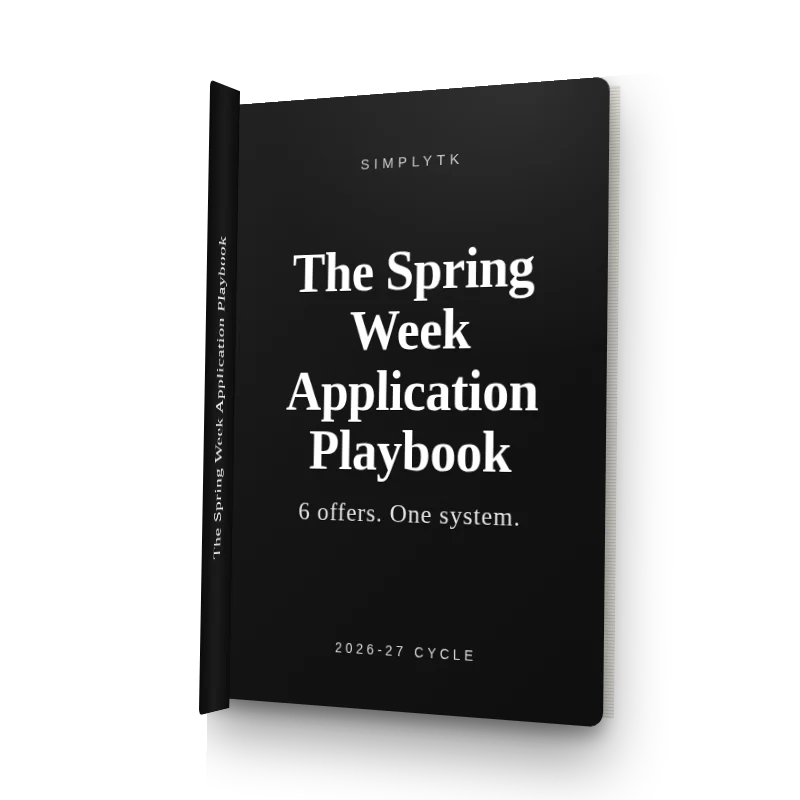
The drills are free. The plan around them is Part 8.
Which provider each firm uses, the 4-6 week plan, what to do in the test, the SJT trick almost nobody uses, and a full chapter on the trading firm tests nobody else covers.
The Spring Week Application Playbook · £19.99, one-time · Free edition available
Questions, answered.
Pick one game and start today.
The Daily Challenge takes ten minutes. When applications open, the tracker tells you which deadlines are live so you are not finding out from a group chat.